Introduction
My name is ASSIA CHABAB, which means (youth), I’m from Morocco, and i have a degree in private law.
I am currently a volunteer in a school kitchen.
I share information about Moroccan culture -its history, traditional clothes,food , language, and customs.
Morocco is a beautiful and diverse country located in North Africa.

History and Culture
Moroccan culture is a unique blend of Amazigh, Arab, and Andalusian influences.
This diversity is reflected in the country’s traditions, architecture, music, and way of life.
Traditional Clothes
Moroccan people wear beautiful traditional clothes that vary by region and occasion.
- Djellaba: a long, loose garment worn by both men and women.
- Caftan: an elegant dress usually worn by women during special events.
Moroccan Cuisine:
Morocco is famous for its rich and flavorful cuisine. Some of the most popular dishes are:
- Couscous: the national dish of Morocco, usually served with vegetables and meat.
- Tajine: a slow-cooked stew made with meat, vegetables, and spices.
- Mint Tea: it is a symbol of hospitality and friendship.
- Moroccan Riyal Rice Salad A colorful and delicious moroccan salad that’s fit for royality
Languages:
Morocco is a multilingual country.
- Classical Arabic is used in schools, the media, and official documents.
- Moroccan Darija is the local dialect spoken in daily life; it includes words from Arabic, Amazigh, French, and sometimes Spanish.
- Amazigh languages such as Tamazight and Tachelhit are also spoken by many people, especially in rural areas.
- french used in administration, hight education, media, and business.
- wedely understood,especially in urban areas.
- spanish spoken mainly in northern regions former spanish protectorate and ceuta ,melilla.
- english less common than french but growing, espicially among young people and in business or education.
ASSIA’S CORNER MOROCCAN:
hello :salam.
how are you?: kirak.
are you okay?: labas.
im fine: bikhir.
what’s your name?: shno smitak.
good morning: sbah lkhir.
thank you: shokran.
beautiful: zin.
now: daba.
school: lmadrassa.
students: tlamad.
yes: wah
no:la
so: ewa

MOROCCAN CULTURE is rich, colorful, and full of traditions that reflect its long history and diversity.
It is a country where ancient customs meet modern life, creating a unique and welcoming culture that I am proud to share.
TRADITION:
1: Drinking moroccan mint tea , a daily habit and famous hospitality tradition.
2: Family evening gatherings time to talk and laugh with all family members.
3: Celebrating festival like eid al fitr and eid al adha, with food and family gatherings.
4: Visitingtraditional markkets moroccans love shopping in souks for fresh products
5: Welcoming gesture of hospitality.
6: Cooking together families prepare food together during special occasions, especially couscous and tagine .
7: Wearing traditional clothes djellabas and caftans for weddings and celebrations.
8: Enjoying music and dance like aita, chaabi, and traditional dances at celebrations.
TRADITIONAL MOROCCAN CRAFTS:
Morocco is famous for its rich and diverse traditional crafts, which reflect the country’s history, culture, and artistic creativity.
some of the most notable crafts include:
1-zellige(MORROCO MOSAIC TILES):colorful geometric ceramic tiles used to create intricate patterns for walls, floors, and fountains.
2-WOOD CARVING: traditional hand-carved wooden furniture, boxes, and decorative frames with detailed patterns.
3-METAL ENGRAVING:skilled artisans engravecopper and brass items such as plates, teapots, and decorative tools.
4-HENNA ART:used in weddings and celebrations, henna creates beautiful patterns on hands and feet.
5- TEXTILES AND WEAVING:handmade carpets, rugs, and embroidered clothing showcasing moroccan colores and designs.
TRADTIONAL CHILDHOOD GAMES:
Moroccan children have played fun and tradtional games for generations.these games teach cooperation,focus and fun with friends.today, we explore some authentic moroccan games loved by both kids and adults.
GAMES OF TODAY:
- Letters game (city,Animal,object,fruit..):players choose a letter and write names for an object, animal, person,or place.this game improves memory and quick thinking.
- Karrie/Small Ball Game: A small handmade ball game played in streets or yards, where kids throw and pass the ball between friends.
- Slingshot Game:making a small slingshot from sticks and string to launch small balls at targets, a precise and skillful game.
- Stone Jump/Tabby: tradtitional game where children jump over squares or stones drawn on the ground.
DARIJA- PROBERBS FOR KIDS:
1-Takbar o tansa :grow up and forget.
this proverb teaches children to stay humble and remember the people who helped them as they grow older.
2-li kayasmae nasiha kayarbah:he who listens to advice wins.
children learn that listening to elders or teachers helps them make better choices and succeed .
dir alkhir talka al khir : do good, receive good.
this teaches kids that good deeds bring positive results and kidness is rewarded.
3- li makayahtaramch lakbir makayahchamch:he who doesn’t respect the elder won’t feel shame .
children learn the improtance of respecting elders to live properly in society.
4-li tsahar mea lbaz yasbah fatar:he who eats suhoor with children ends up hungry .
this proverb humorously advices not to this like children or get involved in their way of thinking too much . ohterwise , you may end up confused of without results. it’s a playful way to warm against letting childrish logic affect your decisions.
5-li bghaha kolha yfarat fiha kolha :he who wants it all , loses it all .
if someone wants everything at once, they usually lose it all or end up with nothing .
6-kon kan alkhokh ydaoui kon dawa raso :if peaches could heal, they would have heal, they would have healed themselves.
this proverb means that people often give advice or pretend to know solutions, but they can’t even fix their own problems. it’s used to mock someone who talks a lot but doesn’t act.
7- li maeando flos klamo masos: the one without money, his words have no flavors.
it means that poor people’s opinions are often ignored, no matter how wise they are.it criticizes society’s tendency to value wealth over wisdom.
8- drabni o bka sbakni o chka:he hit me and cried , then complained before me.
Used when someone does wrong but pretends to be the victim.
9- li darha byadih yfakha bsanih :he who tied it with his hans must untie it with his teeth.
you must solve the problems you created yourself.
10- lafyak bakri man dhab machri :waking up early is bought with gold.
Being early and hardworking brings success and clessing.
11- li gal esida barda ydir yado fiha: the one who said the porridge is cold, should touch it himself.
don’t judge or speak without verifying things yourself.
12- libgha asal yasbar kris nhal: whoever wants honey must endure bee stings.
To achieve something good, you must accept some hardship.
FOOD VARIETY THROUGH THE SEASONS IN MOROCCO
Moroccan cuisine changes beautifully with the seasons. Each time of the year brings its own fruits, vegetables, and flabors, and families adapt their meals to match the weather and mood of every season .
In winter, moroccans prefer warm and comforting dishes such as harira, bissara, lentel stew, couscous with vegetables, and tagine. these meals bring warmth and energy during cold days.people also enjoy plenty of oranges, lemons and pomegranates, rich in vitamins.
In spring, fresh vegetables like peas, fava beans,and spinach appear, and lighter, healthier meals become more common.
During summer, Moroccans enjoy salads, juices, grilled food, and light and tagine with chakchoka .Seasonal fruits like watermelon,melon grapes,and figs are also very popular.
In autmn ,new flavors arrive-apples, pomegranates, nuts and pumpkin-and people start preparing dishes that are sweet and soft ,ready for coming cold.
DURING RAMADAN: Moroccan cuisine becomes even more special . families gather around the table for the evening meal filled with traditional dishes .
The moste famous is harira, a warm soup eaten every night, servedwith chebakia (honey pastries), sellou, boiled eggs,dates,juice, baghrir(moroccan pancakes), and msemen.
Desserts and refreshing drinks are also part of the celebration.
Ramadan in Morocco is not only about fasting -it’s about family warmth, generosity, and the joy of sharing food together.
A TASTE OF MOROCCO THROUGH THE SEASONS.
MUSIC OF MOROCCO
the music of Morocco is rich and diverse, reflecting the country’s history, traditions, and regional cultures. Each style of Moroccan music tells a story – from Sahara desert to the Atlas Mountains and the Atlantic coast.
1- Gnawa Music :
A spiritual and rhythmic music style that comes from sub – saharan africa. it uses instruments like the guembri ( a three- stringed bass ), qraqeb ( metal castanets), and involves trance- like dances.
it is often played during spiritual ceremonies called ‘LiLa’,
2- AITA:
Traditional rural music that tells stories about love, war and daily life. it’s powerful, emotional, and often performed by called ‘chikhate’
3-ANDALUSIAN MUSIC:
A classical style that came from Al – Andalus (spain).it’s elegant and poetic, played with violins, ouds, and tambourines.You can hear it mostly in cities like fes and tetouan.
4-AMAZIGH MUSIC:
Originating from berber traditions, it uses traditional instruments like bendir and lotar.
The songs celebrate nature, freedom , and identity.
5-MODERN MOROCCAN MUSIC:
Today, Moroccan artists mix traditional sounds with pop, rap ellectronic music .
Artistis like Saad lamjarad, Manal , Dizzy dros, and Hatim Ammor bring Moroccan music to the world.
MOROCCAN MUSICAL INSTRUMENTS:
Morocco has a rich musical heritage that combines African, Arab,Andalusian infleunces. Traditional Moroccan instruments give a unique sound to its music.
The “Guembri”,a three- stringed instrument made of wood and camel skin , is often used in Gnawa music , The “Bendir “,a large drum, and the “Tbal”are used in celebrations and weddings.
The “Nay”(flute)and “OUD”(a tring instrument similar to a guitar )add melody and emotion to Moroccan songs.
Together , these instruments create the soul of Moroccan music- full of rhythm , tradition, and joy.
TRADITIONAL POPULAR DANCES IN MOROCCO:
Morocco has many popular traditional dances that reflect its rich culture and history. Each region has its own style and rhythm.In the east, especially in OUJDA,people dance Reggada during weddings and festivals. In other regions, there are dances like chaabi, ahwach , and Gnawa , each with unique music , movements, and traditional clothes. These dances show joy, community and Moroccan cultural pride.
MOROCCAN GEOMETRIC ART:
WHERE MATHEMATICS MEETS MAGIC:
1.INTRODUCTION:
Morocco geometric art is one of the most unique and fascinating artistic styles in the world . it combines mathematics, symmetry, and creativity to creat beautiful patterns.
these desings appear in mosques, places, fountains , and traditional Moroccan houses.
this art shows the intelligence, imagination,precision of Moroccan craftsmen.
2.HISTORY AND ORIGINS:
Geometric art in Morocco has roots in islamic civilization .Because drawing humains or animals was not common in islamic art, artists used shapes like circles, starts,and polygons to express beauty . over the centuries , Moroccan craftsmen developed their own style that becaume famous for its complexity and harmony.
3.MATERIALS AND TECHNIQUES:
Moroccan artisans use differents materials to create geometric patterns , such as :
- WOOD CARVING.
- ZELLIG ( COLORED CERAMIC TILS) .
- PLASTER CARVING.
- METAL ENGRAVING.
- CARPETS AND TEXTILLES.
Each material requires patience and skill. for example, zellige tiles are cut by hand into small pieces with perfect shapes, then arranged into stunning mosaics.
4SYMBOLISM AND MEANING:
The shapes are not random. Every pattern has a meaning:
.Stars represent harmony and connection .
.Circles symbolize unity and infinity.
.Repetitive patterns show the idea of balance and spirituality.
This symbolism makes Moroccan geometric art more than decoration – it is a visual language.
5. Examples in Moroccan Architecture :
You can see this art in many famous places:
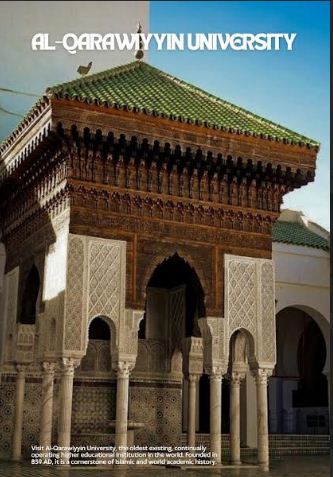
-Hassan ll Mosque – Casablanca.-.Al Qarawiyyin Mosque- Fes.
.Bahia palace- Marrakech .
-Traditional riads .
Public fountains .
These places combine colors, geometry, and craftsmanship in magical way.
6.Modern influence :
Today , Moroccan geometric patterns inspire designers around the world in :
- Fashion.
- Interior design.
- Graphic design.
- Architecture.
The art continues to live because it adapts to moderns life while keeping its soul.
7. Personal Connection:
As a Moroccan, I am proud to share this artistic heritage. Moroccan geometric art represents who we are :creative, patient, spiritual, and connected to our history.
8. Conclusion :
Moroccan geometric art is where mathematics meets magic. It shows how simple shapes can create endless beauty.
Through this art, Morocco continues to inspire and fascinate the world.
Moroccan Architecture :A journey Through Time :
1: Introduction :
Moroccan architecture is a beautiful mix of Amazigh, Arab, Andalusian , and islamic influences.Each building tells a story of history, cultures, and identity. from old medinas to modern cities, architecture in Morocco reflects the diversity and richness of country.
2: TRADITIONAL MOROCCAN HOUSES (Riads):
Riads are traditional homes with on open courtyard in the center . they are designed to protect privacy, keep the temperature cool, and creat a peaceful atmosphere.Riads often include fountains, zellige tiles, carved wood, and beautiful plasterwork.
3. KASBAHS AND BERBER ARCHITECTURE:
In the mountains and desert areas, amazigh (berber)people built kasbahs using clay and starw. these fortified structures are strong, warm in winter, cool in summer, and blend perfectly with nature .
Ait Ben Haddou, for example , is one of the most famous kasbahs in the world.
4. ISLAMIC INFLUENCE:
Mosques, madrasas, and public fountains highlight the spiritual side of Moroccan architecture.
key features include.
- Horseshoe include.
- Decorative zellige.
- Calligraphy.
- cedar wood carving.
- Geometric patterns.
These elements create a feeling of harmony and calm.
5. ANDALUSIAN TOUCH :
Moroccan architecture was influenced by Andalusia (southern Spain ). This appears in :
- Garden layouts.
- water features.
- symmetry .
- floral motives
Examples include the palaces of Marrakech and Fes.
6. MODERN MOROCCAN ARCHITECTURE :
Today, architects mix tradition with modern design. You can see buildings with Moroccan identity but medern materials. this creates a bridge between the past and the future.
HERE IS MY PERSONAL EXPERIENCE AS A VOLUNTEER:
At first, i was nervos because this was my first time traveling outside my country ,but as the days went by. I felt more comfortable and at ease with the team, who
were all very kind.
I felt like i was at home, not at a school.
I have been volunteering for six months snack for the children, assisting the chef in meal preparation, and keeping the kitchen clean. i also took care of animals
such as chickens, fish, and frogs (both small and large ), and watered the plants.
last week, i attended a training session in Braga, where i met some other volunteers.I didn’t meet too many people because I’m naturally a bit reserved. Among
them,I met a spanish volunteer whom i taught some Moroccan words. He asked to learn Darija and expressed his admiration for Moroccan culture. I also met
volunteers volunteers from Germany, Italy, and Turkey.
i learned a lot about making healthy meals for children. I met many people during this experience, which made it even more enjoyable and enriching. this
experience taught me patience , organization, and the importance of teamwork. and i felt like i was contributing to something meaningful for the children.
I’m proud to be part of this team.
I encourage anyone who has the chance to volunteer at this school to it -it’s a wonderful experience full of lessons and beautiful memories.

Deixe um comentário